Serenity Prime Official Website › Blog › How does Serenity Prime work?
How Does Serenity Prime Work? Three Routes a Night-Time Blend Can Take
A blend of 13 names can sound like a mystery. Sorted by purpose, it is easier to follow: a clock signal, a few calming herbs and three nutrients.
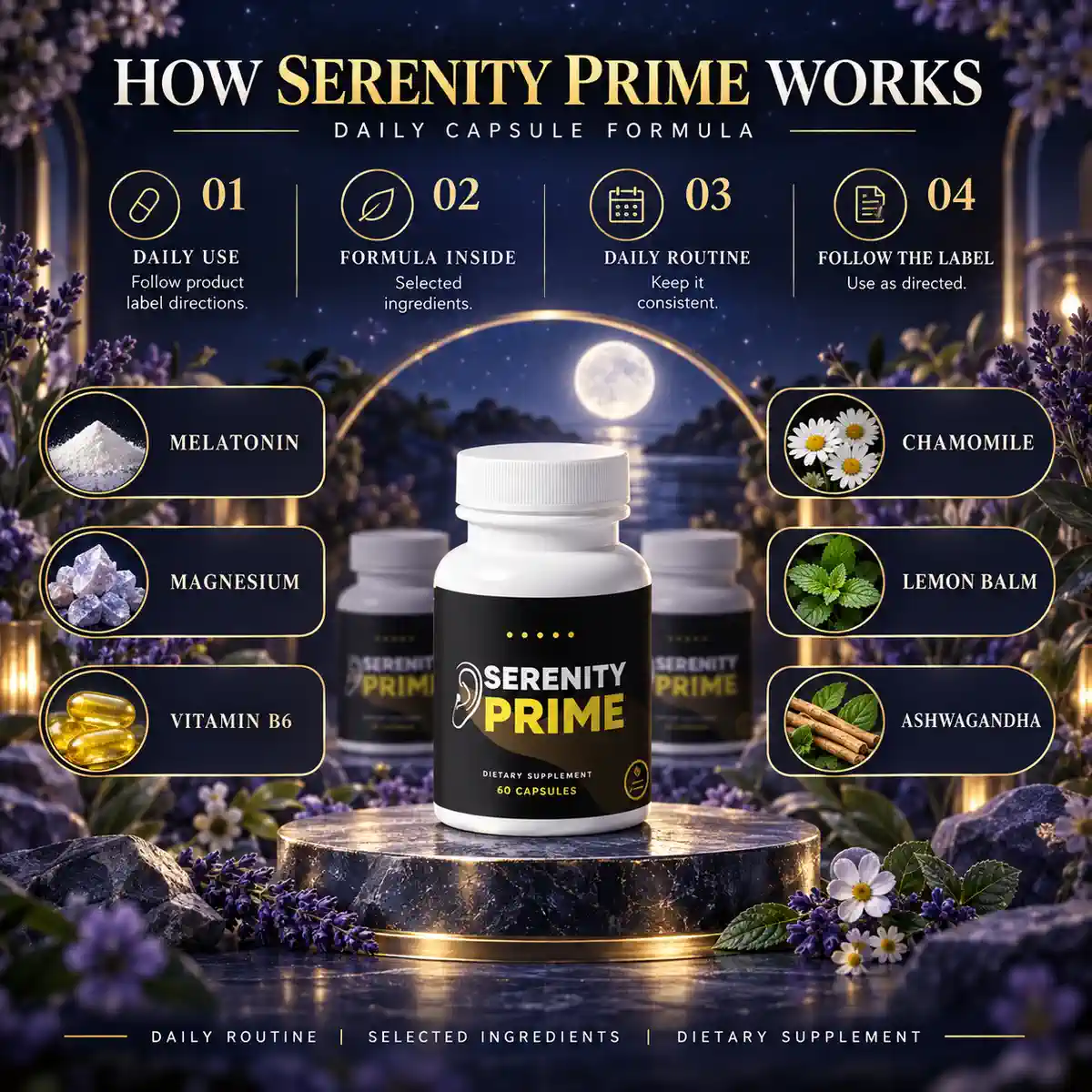
Serenity Prime does not sedate you. Its 13 named ingredients follow three routes: melatonin as a body-clock signal, calming botanicals thought to act gently on the brain's braking system, and nutrients used to build sleep chemistry. These are proposed mechanisms, and the capsule's amounts are not published.
Key facts
- The 13 ingredients fall into three groups: a clock signal, calming botanicals and nutrient helpers.
- Melatonin is a timing signal. It is not a sedative, and more is not stronger.
- Seven of the botanicals are described as acting gently on the same brain system that ordinary sedatives use. That is the proposed mechanism, not a proven effect of this capsule.
- Magnesium, vitamin B6 and calcium are involved in the chemistry that builds melatonin. A shortfall is a plausible reason for poor sleep, which is not the same as making you sleep.
- Hops, L-taurine, calcium and St. John's wort lack direct sleep trials in this form.
- The capsule's amounts are not published, so no mechanism can be sized.
What is the idea behind a night-time blend?
A single ingredient usually pulls one lever. A blend tries to pull several gently. The idea behind formulas of this kind is that poor sleep can have more than one cause, so a blend might help by working on timing, on calm and on the building blocks at once.
None of the three routes is a sedative mechanism, and none acts in a single night. That matters for expectations. Nothing on the list is a sedative drug. A blend like this is meant to nudge a routine, and its research is measured over weeks.
How can melatonin act as a clock signal?
Your brain releases melatonin as light falls. The body reads it as information about what time it is. Taking melatonin repeats that announcement. It does not push you under.
That distinction explains a lot. In a dose-ranging trial in adults over fifty, 0.3 mg restored sleep efficiency and 3.0 mg did not do better. A bigger message is not a clearer message. Pooled data across the research puts the effect on the time to fall asleep at around four minutes, which is small but repeatable.
Melatonin is strongest where the problem is timing, such as a long flight across time zones. It is weaker as a fix for a bad night. Timing matters too, since the dose-ranging trial gave its dose about thirty minutes before bed.
Serenity Prime lists melatonin fourth of 13 and prints no amount. That is the single biggest unknown in the formula, because the whole effect depends on the size of the dose.
What do the calming herbs do?
Several botanicals in the blend have a traditional evening use: chamomile, lemon balm, passiflora, hops, skullcap and ashwagandha, alongside St. John's wort. The modern account is similar for many of them. Their constituents are thought to act on the brain's braking system, which is the same family of receptors that ordinary sedatives target, only far more gently.
- Chamomile. Its proposed active is apigenin. Results are mixed, with an insomnia trial that did not separate from placebo and a nursing-home trial that did.
- Passiflora and skullcap. Described in the same way, with less behind them. One 500 mg dose of passionflower before day surgery reduced pre-operative anxiety.
- Ashwagandha. Classed as an adaptogen. A ten-week trial at 300 mg of root extract twice daily improved sleep in confirmed insomnia.
- Lemon balm. A single 600 mg dose blunted a laboratory stress test, and 300 mg did not.
Notice the language. Thought to, proposed and described as all appear because these are mechanisms people believe in, not effects measured in this capsule.
Curious about the whole pack?
You can see the one-, three- and six-bottle prices at the official checkout, with free US shipping on every pack.
See today's price and guaranteeDisclosure: Serenityprimes earns a commission when you order through this button.
What are calcium, magnesium and B6 doing in a sleep capsule?
These three have a different job. They are not proposed to make anyone drowsy. They help the body turn the amino acid tryptophan into serotonin and then into melatonin, so a shortfall in any of them is a plausible reason for a night to be worse than it needs to be.
Magnesium has the best trial of the three: 500 mg a day for eight weeks moved sleep time and efficiency in older adults with primary insomnia. Vitamin B6 changed dream recall in a five-night study at 240 mg before bed and did not improve sleep itself. Calcium's link to sleep is from nutrition surveys, in both directions, and no trial.
Official ceilings apply to two of them. The upper intake from supplements is 350 mg a day for magnesium and 100 mg a day for vitamin B6 in adults. A blend of this size is unlikely to approach either, but with no published amounts, that cannot be checked.
Which ingredients have gaps in the evidence?
| Ingredient | Gap | What it means |
|---|---|---|
| Hops | Every positive human result pairs it with valerian | There is no valerian in this bottle, so those trials cannot be read across |
| L-taurine | No human sleep trial at any dose | It is in the formula as a mechanism, not a result |
| St. John's wort | Studied mainly for depression | Its documented effect on other medicines is the more important fact for a buyer |
| Calcium | Survey links only | Not a trial of supplementation for sleep |
| Goji | Tested as 120 mL a day of juice for 14 days | Not a capsule fraction |
Drawn from the published research cited on the seller's ingredient pages.
What does work not mean here?
It does not mean sedation, and it does not mean a diagnosis is treated. Serenity Prime is no sleeping pill and no insomnia treatment. Nor does it mean any benefit for hearing, memory or hair.
And it does not mean the same thing for everyone. Light, caffeine, alcohol and a fixed rising time all affect the same nights this formula is sold for. A fair test therefore needs those steady.
Where do these facts come from?
Mechanism descriptions follow the research summaries on the seller's pages. The outside sources named above are listed here.
- The dose-ranging trial in older adults
- The 2005 meta-analysis in Sleep Medicine Reviews
- The Cochrane review of melatonin for jet lag
- The American Academy of Sleep Medicine's prescribing guideline
- The chamomile insomnia trial
- The chamomile trial in older adults
- The pre-operative passionflower trial
- The 2025 skullcap sleep trial
- The ashwagandha insomnia trial
- The lemon balm stress trial
- The magnesium insomnia trial
- The pyridoxine dreaming trial
- The Institute of Medicine reference intakes
- The Institute of Medicine upper intake level for B6
- The NHANES short-sleep micronutrient analysis
- A review of taurine in neurological function
- The fixed valerian-hops trial
- Serenity Prime how it works page
Frequently asked questions
How does Serenity Prime work?
Its 13 named ingredients follow three proposed routes: melatonin as a body-clock signal, calming botanicals, and nutrients used to build sleep chemistry. These are proposed mechanisms, not proven effects of this capsule.
Is Serenity Prime a sedative?
No. Melatonin works as a timing signal rather than a sedative, and nothing on the list is a sedative drug or a controlled substance.
Why does the melatonin amount matter so much?
In the dose-ranging trial 0.3 mg worked and ten times that did not do better. The effect depends on the size and timing of the dose, and the capsule's melatonin amount is not published.
Do the calming herbs have proof?
They have small human trials of varying quality, in different preparations and doses. None was run on this capsule.
What are the nutrients for?
Magnesium, vitamin B6 and calcium help build the chemistry that makes melatonin. A shortfall is a plausible cause of poor sleep, but supplying them is not the same as making you sleep.
How long before it shows?
Expect weeks. The distributor's summary puts the most common wait at 4 to 8 weeks, and the trials behind the ingredients ran four to ten weeks.
Serenity Prime is a dietary supplement, not a drug. It is not FDA approved, and no dietary supplement is. These statements have not been evaluated by the Food and Drug Administration. This product is not intended to diagnose, treat, cure or prevent any disease. Take medical questions to your doctor or pharmacist.
Our view
The reasoning behind the formula is sound as far as it goes. A body-clock signal, a few calming herbs with a long evening history and a set of nutrient helpers is a coherent idea, and it is not asking you to believe anything exotic.
The weak point is the gap between idea and evidence. Several names have no direct sleep trial, one famous pairing is missing its second half, and the amounts that would let you size any mechanism are unpublished.
So read the three routes as a design story, not as a result. They explain why the ingredients are there. Whether the capsule does anything for you is for your own notes and the 60-day window to decide.
See it for yourself
If the three-route idea makes sense to you, the checkout shows the current price and the 60-day guarantee.
See today's price and guaranteeDisclosure: Serenityprimes earns a commission when you order through this button.