Serenity Prime Official Website › How it works
How it worksHow Does Serenity Prime Work?
Serenity Prime takes three routes at once: a body-clock signal, a group of calming botanicals and three nutrient cofactors.
Melatonin carries the timing signal, chamomile and six other botanicals are thought to work gently on the brain’s own braking system, and magnesium, vitamin B6 and calcium supply the chemistry that builds melatonin in the first place. None of the three is a sedative mechanism.
Three mechanisms, the research behind each, and the four different things the word “works” can mean.
How does Serenity Prime work, in one paragraph?
Three routes, one paragraph each, before any of them is examined.
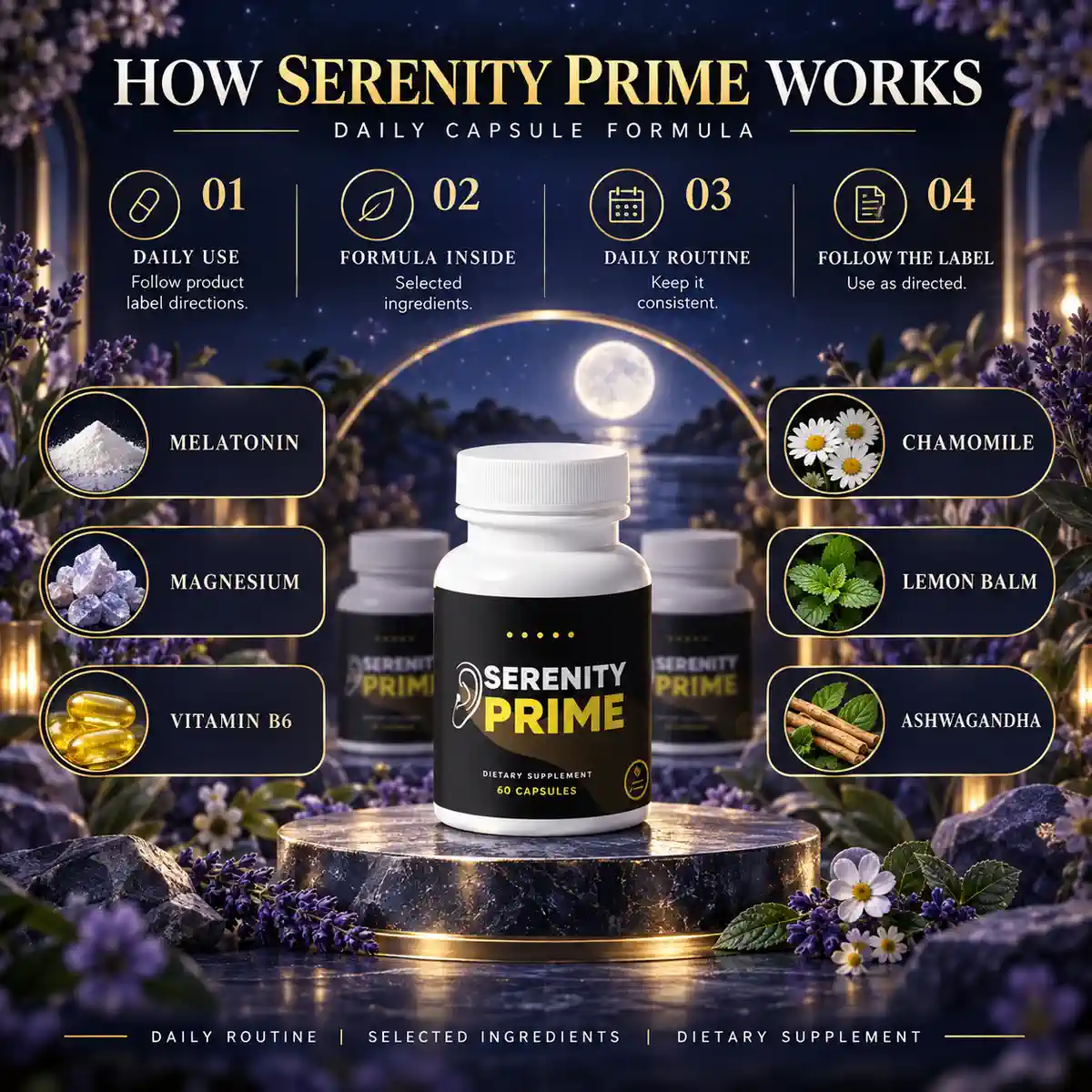
A nighttime blend has three plausible routes into a night’s sleep, and this formula puts at least one ingredient down each of them.
The first is the body clock. Melatonin is the hormone the brain releases as light falls, and taking it acts as a timing signal rather than as a sedative.
The second is the calming side of the nervous system, where several of the botanicals here are thought to act on the same receptor family that ordinary sedatives do, far more gently.
The third is nutritional. Magnesium, vitamin B6 and calcium are cofactors in the machinery that builds serotonin and melatonin out of tryptophan, so a shortfall in any of them is a plausible way for sleep to be worse than it needs to be.
Those three routes are the honest account of how a formula like this is supposed to help. None of them is a sedative mechanism, and none of them acts in a single night.
The body-clock route in Serenity Prime: melatonin as a signal
What melatonin does, why the amount decides it, and the one situation where it is at its best.
Melatonin is the ingredient people recognise, and it is the one most often misunderstood. It is not a sedative. It is the chemical announcement that the day is over, and the body reads it as information about timing.
That distinction has a practical consequence. Taken at the right moment a small amount is enough, and taken at the wrong moment a large amount does very little except leave someone groggy in the morning.
The best demonstration of that is the dose-ranging study in adults over fifty. Three strengths were run a week apart, the middle one being a tenth of a milligram short of a third, and it was that middle strength that restored sleep efficiency. Ten times as much did no better. More was not stronger; it was simply more.
Across the wider literature the effect is real and modest. The 2005 meta-analysis puts the average reduction in the time taken to fall asleep at around four minutes, a later pooled analysis of nineteen trials reaches a similar order of magnitude, and the AHRQ-funded safety and efficacy review reads the primary-sleep-disorder evidence conservatively.
Where melatonin is genuinely strong is a shifted clock rather than a broken night. The Cochrane review of jet lag is the friendliest evidence it has, and the American Academy of Sleep Medicine makes a weak recommendation against it for chronic insomnia in adults. Both of those can be true at once, and they are.
The calming route in Serenity Prime: what the botanicals are thought to do
Seven botanicals, one shared mechanism, and how far each one’s evidence carries it.
Seven of the thirteen are botanicals with a traditional evening use, and the modern account of them is broadly the same in each case: constituents that interact with the GABA system, the brain’s main braking mechanism.
Chamomile is the one most people have already met. Its proposed active is apigenin, a flavonoid that binds at benzodiazepine sites without producing anything like a benzodiazepine effect. Four weeks of a standardised extract, 270 mg twice daily, failed to separate from placebo in primary insomnia, and a slightly smaller 200 mg twice-daily schedule moved questionnaire scores in nursing-home residents. Twelve trials pooled in 2024 come out mildly in its favour.
Passiflora and skullcap are described the same way and have less behind them. One 500 mg dose of passionflower ninety minutes before day surgery reduced pre-operative anxiety, and a 2025 skullcap trial gave 400 mg a day of a characterised extract for 56 days to 66 people with mild to moderate insomnia.
Ashwagandha sits slightly apart from the others. It is classed as an adaptogen and the trial evidence is the strongest in the formula: 300 mg of root extract twice daily for ten weeks improved sleep onset, efficiency and total sleep time in people whose insomnia was confirmed by actigraphy. A 2025 meta-analysis covers its wider mental-health results.
Lemon balm, goji and hops are the remaining three, and each carries a caveat about form rather than about plausibility: lemon balm’s result came from a single 600 mg dose against a laboratory stressor, goji’s from 120 mL a day of a juice, and hops has only ever been tested for sleep with valerian in the same tablet.
The nutrient route in Serenity Prime: cofactors rather than sedatives
Three nutrients that make sleep chemistry possible, which is a different claim from making sleep happen.
Magnesium, vitamin B6 and calcium are on this list for a different reason from the botanicals. They are not proposed to make anybody sleepy. They are required for the reactions that turn tryptophan into serotonin and serotonin into melatonin, and a shortfall is a plausible reason for a night to be worse than it should be.
Magnesium has the best trial of the three. Half a gram a day of elemental magnesium, for eight weeks, moved sleep time and efficiency in older adults with primary insomnia, and three trials pooled together put the shortening of sleep onset at roughly a quarter of an hour. The most recent systematic review is more cautious about how few and how small those trials are, and an earlier review reaches the same conclusion from the other direction.
Vitamin B6 is the coenzyme in the same pathway, and what a large dose of it does is oddly specific. A five-night study at a large evening dose produced more dream material in the morning and no change to sleep itself. That is a genuine finding and it is not a sleep benefit.
Calcium is the weakest of the three and the survey data is honest about it. National survey data places calcium among the nutrients that track sleep duration, a second pass over the same survey found people sleeping badly were more often below par on several micronutrients, and a systematic review reads the whole body of it as an association running in both directions rather than a treatment effect.
What “works” means when Serenity Prime is being judged
Four different outcomes hide behind one word, and a formula can move one without moving the rest.
Sleep research measures at least four different things, and a formula can move one of them without touching the others. Knowing which one matters to you makes the whole category easier to read.
| What gets measured | What it means | What the research here says about it |
|---|---|---|
| Sleep onset latency | How long it takes to fall asleep once the light is off. | The measure most often moved. Around four minutes for melatonin in pooled data, around seventeen for magnesium in a three-trial analysis. |
| Sleep efficiency | The share of time in bed actually spent asleep, counting night wakings. | The outcome that moved in the melatonin dose-ranging trial and in the ashwagandha insomnia trial. |
| Total sleep time | How many hours of sleep the night produced. | Harder to move and moved less often. Reported in the ashwagandha trial. |
| Sleep quality scores | A questionnaire, most often the Pittsburgh Sleep Quality Index. | The primary outcome in the skullcap trial, the chamomile trial in older adults and the passionflower tea study. |
Four measures, four different questions. A change in one of them is not evidence about the other three.
Two practical points follow. The first is that a few minutes off the time taken to fall asleep is a real effect and a small one, and people who expect to be knocked out will read it as nothing at all.
The second is that questionnaire scores and actigraphy often disagree. A person can report sleeping better while a wrist monitor records the same night, and the reverse happens too. Both are legitimate outcomes and neither is the whole story.
Honest critique: what nobody can tell you about how Serenity Prime works
Three limits on the mechanism story, stated once and in full.
Everything above describes how the thirteen named ingredients are understood to act. Three things about this particular capsule are outside anybody’s reach, and they are gathered here rather than repeated in each section.
The amounts settle the mechanism, and no amount is on the label. Every route above has a dose attached to it in the literature. Melatonin has a small effective amount and a large useless one. Magnesium’s trial used 500 mg. Ashwagandha’s used 600 mg a day. Whether this capsule carries a fraction of those or a multiple of them is known only inside the factory.
Nobody has tested thirteen together. Combination pharmacology is not addition, and there is no trial of this formula. The closest published work is the ashwagandha-versus-melatonin trial, which is two of the thirteen and is the most relevant combination study available.
Two routes may be partly redundant. A capsule containing both melatonin and ashwagandha carries two ingredients that were compared head to head in that same trial. That is a formulation choice with a defensible rationale, and it is not the same as two independent effects stacking.
Questions about how Serenity Prime works
Is Serenity Prime a sedative?
No. Nothing on the list of thirteen is a sedative drug. Melatonin is a timing signal, the botanicals are proposed to work gently on the brain’s own braking system, and the minerals are cofactors. A supplement that genuinely sedated anyone would be regulated as a medicine.
How fast does Serenity Prime act?
Not in one night, on the evidence available. The trials behind the botanicals in this formula ran from seven nights to ten weeks, and the distributor’s own figures say the most common wait reported by buyers is 4–8 weeks. The results timeline page sets the trial durations out week by week.
Does the melatonin in it reset a body clock?
Melatonin can shift a body clock, which is a different job from ending a bad night. The Cochrane jet-lag review is where that evidence is strongest, and the timing of the dose matters more than the size of it for that purpose.
Do the ingredients work together?
One pair on this list has been trialled together in people, magnesium and vitamin B6, and that was for restless legs rather than insomnia. Nobody has tested the thirteen as a group. A blend is a formulation judgement, and it should be read as one rather than as thirteen results stacked up.
Why does a sleep supplement contain St. John’s wort?
Its own evidence base is for depressive symptoms rather than for sleep, and low mood and poor sleep travel together, which is the likely rationale. It is also the one ingredient on the list with a well-documented set of drug interactions, which the side effects page covers in full.
Does it contain anything that could keep somebody awake?
Nothing on the list is a stimulant. Vitamin B6 at a large dose has been shown to increase dream recall, which some people find disruptive and others find interesting, and that was measured at 240 mg before bed in a five-night study.
Sources for the Serenity Prime mechanism
Each route in turn, with the trials that describe it.
- Zhdanova IV, Wurtman RJ, Regan MM, et al. Melatonin treatment for age-related insomnia. J Clin Endocrinol Metab. 2001;86(10):4727-30. PMID 11600532. https://pubmed.ncbi.nlm.nih.gov/11600532/
- Brzezinski A, Vangel MG, Wurtman RJ, et al. Effects of exogenous melatonin on sleep: a meta-analysis. Sleep Med Rev. 2005;9(1):41-50. PMID 15649737. https://pubmed.ncbi.nlm.nih.gov/15649737/
- Ferracioli-Oda E, Qawasmi A, Bloch MH. Meta-analysis: melatonin for the treatment of primary sleep disorders. PLoS One. 2013;8(5):e63773. PMID 23691095. https://pubmed.ncbi.nlm.nih.gov/23691095/
- Buscemi N, Vandermeer B, Hooton N, et al. The efficacy and safety of exogenous melatonin for primary sleep disorders. A meta-analysis. J Gen Intern Med. 2005;20(12):1151-8. PMID 16423108. https://pubmed.ncbi.nlm.nih.gov/16423108/
- Sateia MJ, Buysse DJ, Krystal AD, et al. Clinical Practice Guideline for the Pharmacologic Treatment of Chronic Insomnia in Adults: An American Academy of Sleep Medicine Clinical Practice Guideline. J Clin Sleep Med. 2017;13(2):307-349. PMID 27998379. https://pubmed.ncbi.nlm.nih.gov/27998379/
- Herxheimer A, Petrie KJ. Melatonin for the prevention and treatment of jet lag. Cochrane Database Syst Rev. 2002;(2):CD001520. PMID 12076414. https://pubmed.ncbi.nlm.nih.gov/12076414/
- Zick SM, Wright BD, Sen A, et al. Preliminary examination of the efficacy and safety of a standardized chamomile extract for chronic primary insomnia: a randomized placebo-controlled pilot study. BMC Complement Altern Med. 2011;11:78. PMID 21939549. https://pubmed.ncbi.nlm.nih.gov/21939549/
- Adib-Hajbaghery M, Mousavi SN. The effects of chamomile extract on sleep quality among elderly people: A clinical trial. Complement Ther Med. 2017;35:109-114. PMID 29154054. https://pubmed.ncbi.nlm.nih.gov/29154054/
- Kazemi A, Shojaei-Zarghani S, Eskandarzadeh P, et al. Effects of chamomile (Matricaria chamomilla L.) on sleep: A systematic review and meta-analysis of clinical trials. Complement Ther Med. 2024;84:103071. PMID 39106912. https://pubmed.ncbi.nlm.nih.gov/39106912/
- Movafegh A, Alizadeh R, Hajimohamadi F, et al. Preoperative oral Passiflora incarnata reduces anxiety in ambulatory surgery patients: a double-blind, placebo-controlled study. Anesth Analg. 2008;106(6):1728-32. PMID 18499602. https://pubmed.ncbi.nlm.nih.gov/18499602/
- Di Minno A, Morone MV, Buccato DG, et al. Efficacy and Tolerability of a Chemically Characterized Scutellaria lateriflora L. Extract-Based Food Supplement for Sleep Management. Nutrients. 2025;17(9):1447. PMID 40362800. https://pubmed.ncbi.nlm.nih.gov/40362800/
- Langade D, Kanchi S, Salve J, et al. Efficacy and Safety of Ashwagandha (Withania somnifera) Root Extract in Insomnia and Anxiety: A Double-blind, Randomized, Placebo-controlled Study. Cureus. 2019;11(9):e5797. PMID 31728244. https://pubmed.ncbi.nlm.nih.gov/31728244/
- Marchi M, Grenzi P, Travascio A, et al. The effect of Withania somnifera (Ashwagandha) on mental health symptoms in individuals with mental disorders: systematic review and meta-analysis. BJPsych Open. 2025;11(6):e260. PMID 41140145. https://pubmed.ncbi.nlm.nih.gov/41140145/
- Movva N, Salve J, Wankhede K, et al. Comparative Evaluation of Ashwagandha (Withania somnifera) Root Extract and Melatonin for Improving Sleep Quality in Adults. Clocks Sleep. 2026;8(2). PMID 42029558. https://pubmed.ncbi.nlm.nih.gov/42029558/
- Kennedy DO, Little W, Scholey AB. Attenuation of laboratory-induced stress in humans after acute administration of Melissa officinalis (Lemon Balm). Psychosom Med. 2004;66(4):607-13. PMID 15272110. https://pubmed.ncbi.nlm.nih.gov/15272110/
- Amagase H, Nance DM. A randomized, double-blind, placebo-controlled, clinical study of the general effects of a standardized Lycium barbarum (Goji) Juice, GoChi. J Altern Complement Med. 2008;14(4):403-12. PMID 18447631. https://pubmed.ncbi.nlm.nih.gov/18447631/
- Abbasi B, Kimiagar M, Sadeghniiat K, et al. The effect of magnesium supplementation on primary insomnia in elderly: A double-blind placebo-controlled clinical trial. J Res Med Sci. 2012;17(12):1161-9. PMID 23853635. https://pubmed.ncbi.nlm.nih.gov/23853635/
- Mah J, Pitre T. Oral magnesium supplementation for insomnia in older adults: a Systematic Review & Meta-Analysis. BMC Complement Med Ther. 2021;21(1):125. PMID 33865376. https://pubmed.ncbi.nlm.nih.gov/33865376/
- Lopresti AL, Smith SJ, Drummond PD. Magnesium Supplementation for Sleep in Adults: A Systematic Review of Randomized Controlled Trials. J Diet Suppl. 2026;23(5):553-581. PMID 42661485. https://pubmed.ncbi.nlm.nih.gov/42661485/
- Arab A, Rafie N, Amani R, et al. The Role of Magnesium in Sleep Health: a Systematic Review of Available Literature. Biol Trace Elem Res. 2023;201(1):121-128. PMID 35184264. https://pubmed.ncbi.nlm.nih.gov/35184264/
- Adventure-Heart DJ, Madden NA, Delfabbro P. Effects of Vitamin B6 (Pyridoxine) and a B Complex Preparation on Dreaming and Sleep. Percept Mot Skills. 2018;125(3):451-462. PMID 29665762. https://pubmed.ncbi.nlm.nih.gov/29665762/
- Grandner MA, Jackson N, Gerstner JR, et al. Dietary nutrients associated with short and long sleep duration. Data from a nationally representative sample. Appetite. 2013;64:71-80. PMID 23339991. https://pubmed.ncbi.nlm.nih.gov/23339991/
- Ikonte CJ, Mun JG, Reider CA, et al. Micronutrient Inadequacy in Short Sleep: Analysis of the NHANES 2005-2016. Nutrients. 2019;11(10):2335. PMID 31581561. https://pubmed.ncbi.nlm.nih.gov/31581561/
- Ji X, Grandner MA, Liu J. The relationship between micronutrient status and sleep patterns: a systematic review. Public Health Nutr. 2017;20(4):687-701. PMID 27702409. https://pubmed.ncbi.nlm.nih.gov/27702409/
- Apaydin EA, Maher AR, Shanman R, et al. A systematic review of St. John's wort for major depressive disorder. Syst Rev. 2016;5(1):148. PMID 27589952. https://pubmed.ncbi.nlm.nih.gov/27589952/
Give Serenity Prime the run its research asks for
The trials behind these ingredients ran four to ten weeks, and the three-bottle pack covers ninety days. Free US shipping, and 60 days from purchase to change your mind.
One bottle $69 · six bottles $294 · 60-day money-back guarantee
Order Serenity Prime On The Official Website60 capsules a bottle · lot SER-26/SE-3930 · free US shipping